Showing posts with label art. Show all posts

Saturday, August 25, 2012

Señora Cecilia: Art Restorer to The World!


By now, you must live under a rock if you haven't heard about the poor Spanish elderly lady who took it upon herself to restore a badly damaged 19th century portrait of Jesus in a church in Borja, Spain. You probably have seen the appallingly funny before and after pictures.
The story is very touching. She did it with the permission of the priest. According to her, people would walk into church and watch her at work and no one said a peep until she finished her masterpiece, which is now her gift to the world. While it is true that the poor soul became a laughingstock worldwide, something more interesting happened. Had we not lived in the day of internet and memes, we would have seen her in the evening news, shaken our heads, and moved on. But Señora Cecilia's good intentions have unleashed a wave of memes that are not only very funny, but that put art where it hasn't been in ages, at the forefront of popular culture EVERYWHERE.


While funny memes are born every day, memes about art are rare, and the ones inspired by Señora Cecilia's artistic inclinations help people remember how difficult it is to achieve good art. The idea that anybody can sidle up to an old fresco and retouch it is surreal. Who walks into a church, looks at a peeling antique and thinks they can fix it? She singlehandedly has made people appreciate how challenging it is to make art. Even unprepossessing art, like the one she fixed. It's not like she defaced a Velázquez. Her masterpiece is also now gracing some of the most iconic art in the history of Western civilization.


There are many people, including me, who feel sorry for her. But I don't feel so sorry that I'm not  enjoying immensely some of the viral things people are coming up with. The purity of her intentions have made her a hero to many. I'm not ready to give her such a pass. Such epic cluelessness has to be addressed. But her touching desire to help is just as epic. I hope she takes it all in stride and people forgive her. She should be proud of how inspiring she has been to the world!


I don't think the memes are personal affronts to her. At this point they transcend laughing at her. A lot has to do with Spanish culture, where already there is talk of squadrons of señoras that are itching to restore stuff. Check any Almodóvar movie. There is always one such essential, folkloric Spanish old lady. She is usually played by the genius actress Chus Lampreave (who should play Señora Cecilia whenever Hollywood options the rights). These Spanish small town señoras are miraculously untainted by malice, they are enterprising and well-meaning and a little dim, and they are all a hoot, because they live with one foot in the modern world and the other one in the 18th century. Beyond Spain, the memes are a comment on the nature of art itself. Take a masterpiece and try to make it better. Jesus ends up looking like a monkey.
Señora Cecilia has unleashed a global wave of creativity where art is at the forefront of the popular buzz, so we have much to thank her for. For one, the restored painting is far more interesting now. It has a sweet art naif quality and it certainly doesn't look like the trillion other suffering Christs that exist in abundance in every church in every Catholic country and are virtually undistinguishable from one another. The town of Borja should be grateful: she just put it on the map. There should be busloads of tourists flocking to that church like pilgrims going to Lourdes in search of miracles.
Imagine the headlines: "New Face of Christ Discovered on Old Face of Christ". In this case, it's worth trying to emulate the saintly goodness of Señora Cecilia, the lady who wanted to make Jesus look better.


Monday, August 06, 2012

The Immortal Chavela Vargas


Mexico will honor the passing of the great singer Chavela Vargas with an open casket viewing in the Palace of Fine Arts today. If I could go pay my respects, I would. Gone is one of the greatest singers in the Spanish speaking world.
I first met Chavela Vargas when I was a child. She was a neighbor of my uncle, who had a house near Cuernavaca in Ahuatepec, a place she wrote a beautiful song about.
At the time, by ten in the morning she already had several tequilas on her. She liked to come over to sing and eat and drink some more. She was always warm and funny. She used to call my cousin Carlos, who was a big boy, her "sietemesino de oro": her golden seven-months preemie. Sometimes she brought her guitar and she sang for us, with that torrential voice of hers, which at the time was still unbroken. My uncle eventually sold the house and I never heard from Chavela again. In fact, many people thought she had died, given her penchant for hard drinking.  It wasn't until the 1990s, when she was in her seventies, that she resurfaced in Mexico, after going through a scare with tongue cancer (she also smoked cigars). She was brought out from semi-obscurity by the owners of a bohemian nightclub in Mexico City, where she used to hold court to packed, adoring audiences. I saw her sing in that intimate space many times. Not once did I ever manage to make it through one of her performances without dissolving in hot tears of pain, joy and gratitude. She was one of the most powerful performers I have ever seen. She seemed to tower onstage, wearing her very elegant ponchos, accompanied only by a guitar player. I remember meeting her backstage after one of her shows and being shocked at how tiny and almost frail she seemed offstage. But when that raspy voice of hers boomed out, she made your heart quake. She used to have more or less the same repertoire of great Mexican ranchera songs every night, but each time she sang one of those torch songs (we call them slash-your-wrists songs) it was as if it was coming out of her guts for the first time. She gave her soul in every song. And the feeling was not maudlin, self-pitying, or forced. It was brutal. It was tough. It was raw. As real and as strong as an earthquake. But then after each song she would make funny jokes about her now sadly abstemious life or engage the audience in puckish repartee.
I remember a very funny story she told one night about going to the Royal Palace in Madrid to sing for the Spanish royal family. King Juan Carlos was her friend. They invited her over for dinner, she had a great time. When it was time to leave, she put on her raincoat and left. It felt a little big on her. When she got to the hotel, she realized that she had taken the King's raincoat, and she found the King's wallet, with the King's credit cards in it. She then imagined King Juan Carlos trying to fit into her raincoat. Whether this is made up or not, it was such a lovely way to conveying to us her own royalty and humility. For those of us who were transformed (mostly into helpless pools of tears) by her power, she was regal. She was a goddess, which is what fans in the audience screamed at her at the end of each song. I am extremely sad to see her go, but I'm glad to know she lasted with power, grace and humor until the end. She had one of the greatest second acts in life. We have been bestowed with the extraordinary luck to have heard her sing her heart out.


Sunday, June 03, 2012

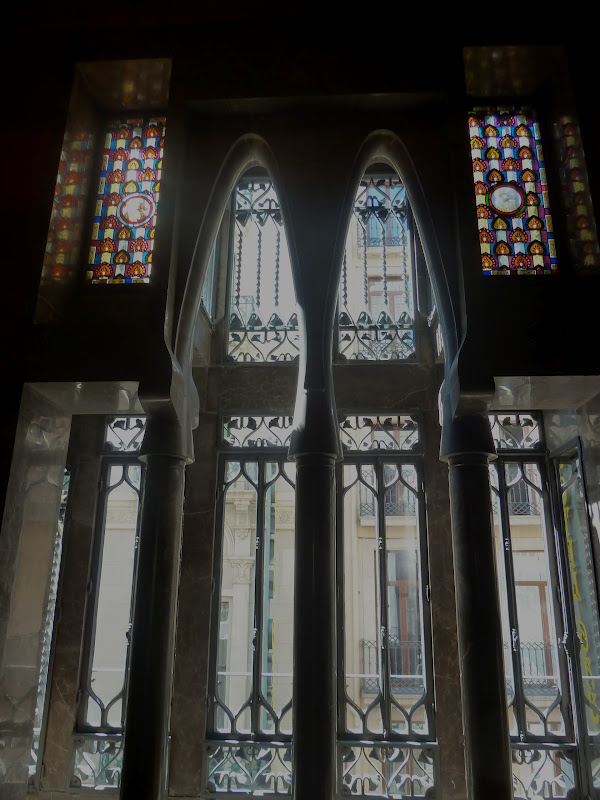
Gaudí Is In The Details


Casa Batlló: the one that looks like a creature from the sea.
Photos: Yehudit Mam.


Thursday, May 31, 2012

Viva Gaudí!

I used to think Frank Lloyd Wright was my favorite architect ever, but I was wrong. It's Antoni Gaudi, whose insanely beautiful Palau Guell, the private house of Gaudí's biggest patron, is now totally restored.
Gaudí's work only looks insane, but it isn't. There is gorgeous harmony, expansive space, and absolute beauty. The Guell Palace is certainly a strange house, but it is a thing of genius. It reminded me of the prints of M.C. Escher.


The incredible wrought iron doors designed by Gaudí allow you to see the street from inside but prevent you from seeing the house from outside.

The horse stables


The Guells only lived there for about 15 months, because Mrs. Guell didn't like the house.

Monday, August 02, 2010

Phil Kelly


Amarillo Anáhuac
I'm very sad to learn that my friend Phil Kelly passed away last night in Mexico City, the city he loved and that loved him back. Phil, who was originally from Ireland,  painted his adopted city with wit and verve. Not many local painters train their eyes on the urban jumble that is Mexico City; not many people can see the beauty beneath the grime, but Phil did. He could look at its ugliest buildings, its most impossibly trafficked intersections, its mustiest cantinas, and bring them to life with loose but precise strokes and an amazing use of color: witty, generous, expressive, and never overwhelming. He could distill the essence of a place and fill it with light. His paintings of Mexico City, Oaxaca and other cities afford you a totally new way of looking at places that you recognize, even if you've never been there.

I am very lucky to have a Phil Kelly, a generous gift from Mr. Ex-Enchilada. It's an oil painting of Paseo de la Reforma, Mexico City's version of the Champs Elysees.
In Phil's hands, the avenue is a vertiginous river of cars, an orange swath of paint, stubborn blue palm trees billowing in the exhaust wind, and what I most love about it, a sky the color of clotted cream, a classic Mexico City sky on those days where your throat itches and your eyes water. Rising in the middle of this wide panorama is the Monument to the Independence, El Ángel, almost dwarfed by all that crazy motion around it, but still shining over the fierce metropolis like a little fairy.


I saw Phil last January in Mexico City. I parked myself at the Xel-Ha and let people know I was there (something you can do at the cantinas of Mexico City, where there is always one more chair to add to any table). Not many came but I was happily surprised when Phil arrived with his indomitable wife Ruth. Sweetly, he came bearing  gifts for my birthday. A lovely little etching and a lovely little book with some of his paintings of Mexico.

El Angel

Circuito de Noche

León Condesa Jardín Principal
Circuito
I met Phil when I was in my twenties and moving out of my parents' house to go live in la Condesa (in those days it was full of old Jews and new artists, and gracefully bereft of enforced hipness). I moved into Phil's bedroom in an old apartment building in Campeche Street. Phil moved out to a bigger place where he had much more room to paint, and if I'm not mistaken, which was his home and studio until last night.
Phil had a wicked sense of humor and he was a lovely man. I'm very sad that he is gone. But we are lucky that he left behind all that color, all that incredible art.

Parnell Square, Dublin, I believe


If this isn't Paris, I don't know what is. 

Mexico City, no doubt.

Saturday, February 13, 2010

Portrait of My Dad...

...by Diego Rivera. You can read the story of how this happened here.


Thanks to my Small Enchilado Brother in Law for sending me the picture.

Monday, February 01, 2010

Diego Rivera and My Dad

Family lore has it that Diego Rivera asked my dad about how to write Hebrew letters for his mural Man Controlling The Universe which is on the second floor of the Palace of Fine Arts in Mexico City. Apparently, my dad, all of 9 years old, would come and watch him paint. They became friends.


The mural is from 1934. If you look on the right bottom side of the mural, where the red banner is, this is what you'll see, sadly fading today:

Trotsky, Marx and Engels with the banner of the IV International Socialist Congress.
I took this photo last Friday.  Look closer:

 
In Yiddish:  Arbeter fun ale lender fareinikt aich in Fertn Internatzionale Sotzializt.
Workers of the world unite in the Fourth International Socialist.
Makes sense, cause my Dad didn't speak Hebrew but he spoke Yiddish.
Diego gave my dad a pencil portrait sketch of his young likeness. It is signed and dedicated, "a mi amigo Aarón Maam, Diego Rivera". That's not how we spell our last name, but never mind. Apparently my dad folded it and put it in his pocket. Years later my mom ironed it and they had it framed. It's the head of a smiling boy, with thin hair, and almond shaped clear eyes. It doesn't look anything like my dad, but it does look a lot like my nephew Daniel. Go figure. 

 
My dad was friends with Diego until the fifties, when he got very disenchanted with Stalin and his murderous anti-intellectual, anti-Semitic and inhuman politics. Diego adored Stalin regardless, and he and my Dad never spoke again.


Pedro Friedeberg

At the Camino Real Hotel in Mexico city there is a mural by this Mexican artist (born in Italy, he escaped Mussolini with his mother when he was a child), that always fascinated me when I was a little girl. It was kinda of psychedelic but very geometric. Fun and gorgeous. Super extra groovy. Friedeberg was mostly known for the invention of this:

 
The hand chair, which according to the current retrospective of his art at Bellas Artes, was coveted by hip seventies icons such as Yul Brynner and Roman Polanski. Friedeberg was not only a late surrealist but a mischievous wit and he said (and I paraphrase) that it was amazing to him that he became famous for a lazy, vulgar piece of work that was actually built by a carpenter, but his other work which consumed hours of his time, nobody paid any mind to. Well, here is some of it:


Project for the Remodeling of Toluca (he originally studied architecture)

 
This one is called Vagina Dentata


And these are his interpretations of the Kabbalah tree. 


As you can see, he combines esoteric influences with op art and surrealism. Back in the day when there was no Adobe Illustrator. The titles of his works are very funny.


He was much a product of his time, but I think his art is still extremely cool today. 
The guy is still around and looks like he's having fun.