Showing posts with label Advertising. Show all posts

Wednesday, April 12, 2017

The Pepsi Generation


My answer to a commenter in the New York Times who was offended that Black people were offended by this ad and could not for the life of him understand why:
The problem with this ad is that there is total cognitive dissonance between the situation it depicts, some sort of defanged political protest, with the product it shills, which is sugary brown water with bubbles. So even if you cannot possibly conceive how some people may think that this idiotic ad trivializes history, the ad is a disaster because a Pepsi cannot ever do what the ad claims it can. A Pepsi cannot have a starring role in a political protest unless it's a molotov cocktail...
The ad is completely divorced from reality. It's the idiotic trivialization of our moment in time, in which people are compelled to protest about seriously important issues. Its inappropriate borrowing of civil rights imagery also trivializes a very serious fight for justice that still continues.
This tweet from the daughter of Martin Luther King about sums it up:


Yet the marketing geniuses at Pepsi, in their world of consumer research and data points and whatnot, decided to use the moment to tell the wrong story. This is what I think went down:

Marketing person 1: Our research shows millennials are independent and they like to protest.
Marketing person 2: Celebrities have always worked for Pepsi.
Marketing person 3: Kendall Jenner is a millennial and a celebrity.
Marketing team: Bingo!

A Frankenstein is born.

 I define advertising as the translation of marketing into human terms. The problem with marketing is that it thinks it is about people but it isn't. It's about consumers, people who are categorized exclusively by what they buy. Marketing puts consumers into social, economic and educational brackets. There could have been diverse people in the team responsible for this disastrous ad but apparently unlike this SNL spoof, nobody thought to check with a real human. Professional focus group goers don't count. They get $50 bucks and an endless supply of soda, M&Ms and mini-pretzels, and for this reason, everything they say comes out of their ass. That companies don't yet realize this never ceases to amaze me.

As for the execution, the ad is a parade of wrongness. From frame one, everything is wrong. Starting with this anemic Kardashian taking off a blonde wig and smearing her lipstick away before she confronts the police. This is wrong on so many levels, I think I need someone in the order of Slavoj Zizek to explain it to me. Wrong spokesperson, wrong gesture, wrong situation, starring a beverage that was not really designed to either bring about world peace or neutralize the police.
We have stonewashed denim circa 1980, because someone thinks this is cool. If you notice, everyone is wearing blue, Pepsi's brand color. I would not be surprised if the color red was verboten on set, because that is the color of you-know-who.
Then we have the fake Muslim female photographer, the faux-edgy Black guy with the cornrows, the Asian cello player, the inane protest signs that read "join the conversation". Everybody looks like they've come out from an audition for the Mickey Mouse Club (for people of color). They are so scrubbed of personality, they must be representing the working class of Stepford, Connecticut. Don't get me started with the police, who seem to be armed to the gills with walkie talkies.

There are always people who feel superior to the people who like to discuss tone deaf commercials or movies, like that commenter in the New York Times and sundry self-appointed Cassandras on social media. These people always claim that "it is only a movie" or "only a commercial". They like to point out how superficial we are by reminding us that there are worse atrocities in the world that, according to them, no one talks about. Well, they are wrong. We all know that the world is full of suffering, and we are all dismayed. I don't see them joining the White Helmets. But this doesn't make it less important for people to discuss pop culture phenomena, particularly when it generates such a vociferous response. Why shush the debate? Just because it comes from entertainment? Entertainment can be a pretty ruthless mirror to ourselves. The outcry is important because it shows us who we are and what is going on in our society. We don't all have to agree, but it's good to talk about it. People who pooh-pooh these discussions by flaunting their moral superiority actually undermine what the debate is all about.


Wednesday, December 02, 2015

Open Unhappiness


I haven't seen a more offensive advertising since Donald Trump last opened his mouth. Mistakenly thinking that its role in society is to do good, Coca-Cola Mexico came up with a campaign to "open your heart" and "break prejudice". Which is fine. We don't listen to someone like the Pope when he exhorts us to do the same, but if Coke says it, the entire Mexican nation is sure to follow through. After all, it is a known fact that Mexicans drink far more Coke than water.
In the commercial, a bunch of young white models, all behaving in slow motion, get into a hipstery looking truck, and, supremely enamored of their own munificence, arrive at an indigenous Mixe village in Oaxaca to spread their self-congratulatory, privileged joy. There, instead of bringing education, jobs, better housing, opportunities, water, curiosity, respect, understanding, equality, any sort of practical help, or simply begging humbly for forgiveness, they unload coolers filled with ice-cold Cokes and, armed with plywood, "build" a hideous Christmas tree made of Coca-Cola bottles that happens to look like a deformed Coke bottle and which says something like "let's keep the unity" in the Mixe language.
According to The Guardian, where you can still see the spot, there were calls to take this preposterous garbage off the internet, for the expected reasons: patronizing the Mixe people, and by extension all the indigenous cultures of Mexico, while encouraging their consumption of a drink that can only hasten their tooth decay, their diabetes, and their death.
To me, this, although true, is not the biggest problem. I love Coke and will love it until it causes my untimely demise. In my case, the demonization of its sugar content falls on deaf ears.

Forget about the tone-deaf impropriety of a foreign company that peddles what many people consider syrupy poison telling Mexicans how to deal with their "prejudice".
Forget about the absurd appropriation of a Christmas tree by discarded product.
Forget the wholesale contempt for the original religious and cultural traditions of the indigenous Mexican peoples.
Forget about the imposition of Christmas, consumerism, cavities and Coca-Cola by a bunch of insufferable rich twats pretending to "give back" while they look down on the "indians".
Forget, if you can, the plywood.
What makes one retch is the abject cluelessness of an ad that preaches against prejudice while completely avoiding the vast majority of Mexicans, who are neither resplendent white specimens nor indigenous people.
Where are the people who represent most Mexicans, not just the ones at the very top and the very bottom of society? Where's the working class? Where's that mythically expanding Mexican middle class everyone talks about? In short, where are all the other brown people?
As is traditional in Mexican advertising, they don't exist. They are rarely, if ever to be found in a commercial.
This ad is no different from the great majority of ads in Mexico, which, unless they are public service announcements, almost exclusively cast people who seem to have arrived recently from Scandinavia or the tonier confines of Buenos Aires. But in this case, for maximum absurdity and bitter unintended irony, it also stars, probably for the first time in the history of Mexican corporate marketing, a number of forsaken natives, and not even this fact could make the advertising agency, the casting agency, the director and the client consider representing all the rest of the actual people who drink their beverage, and who are hounded every second of their lives by the racism the ad purports to fight.
People who deny that Mexican society is predicated on the most enduring, insidious racism need to be subjected to an endless loop of this ad, like Malcolm McDowell in A Clockwork Orange.
So do the people who made it. Ad infinitum.

Monday, July 20, 2015

Airbnb, Or The Limits of Advertising.


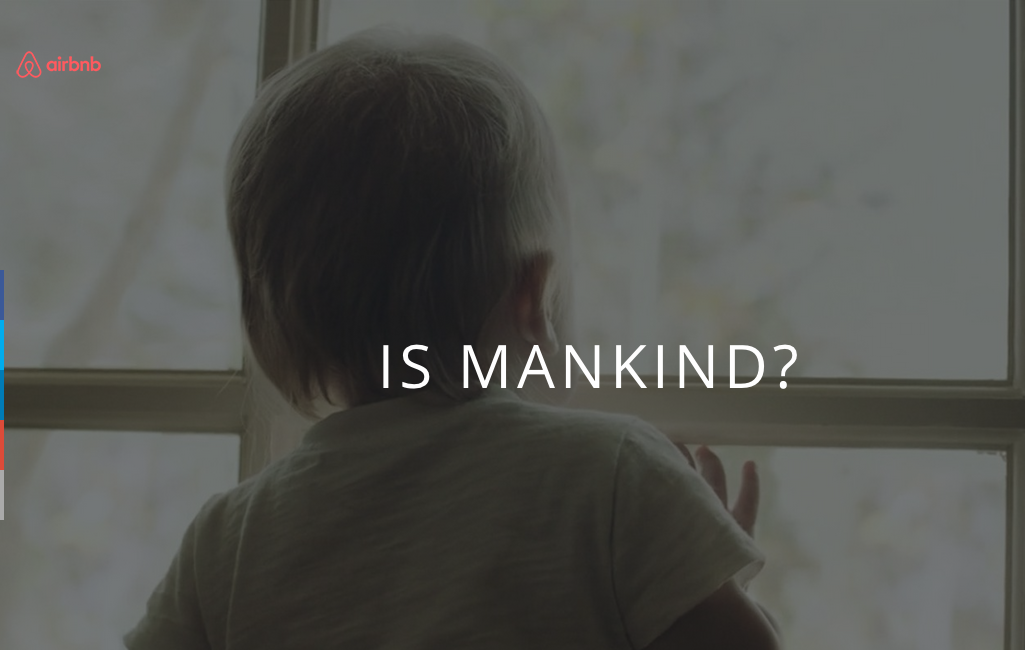
Perhaps you have seen the Airbnb ad at your local cinema where a comely young woman travels the world, staying in wonderful houses, (with pools!) surrounded by lovely people who soon become like family and take her to karaoke bars in Tokyo. Or the one about a baby peering out a window, a blatant rip-off of Terence Malick's Tree of Life, poetic mumbo jumbo included. Their new campaign concept is "Is Mankind?" Well, to judge from my own personal experience renting from Airbnb, the answer is "no".
Airbnb's marketing and advertising make it sound like their business proposition, in which total amateurs supplement their income by becoming innkeepers overnight is about community, sharing and humanity. And perhaps it is, in a few miraculous cases. But there is a chasm from here to Pluto between Airbnb's aspirational imagery and the reality of the business. And I think this sets both hosts and guests up for bitter disappointment. This gulf between the ads and reality reminds me of those cigarette ads from the fifties in which doctors endorsed smoking Lucky Strikes for good health.
It's all about managing expectations. People point out to me that making a buck from strangers by renting them your house is not new. Before Airbnb, people did it through Craigslist and other channels. But because there was no marketing, people were ready to expect ghouls, both as hosts and guests. Nobody expected veritable angels of mercy to descend on a property. After some back and forth to make sure nobody involved was a card-carrying psycho, you hoped for the best and braced for the worst. Airbnb provides a well-organized platform to do the same thing. However, they have also decided to brand themselves as the paragon of human kindness, and this is where expectations are squashed.
Now, I don't know about you, but for the life of me, I will never understand what people like about staying in the houses of strangers. Give me a hotel: clean, well managed, with a good mattress and decent towels, and I'm all set. You say: "oh, but it is generic, it is anonymous". Anonymous makes me horny. I hate bed and breakfasts. I have nothing to say to total strangers early in the morning. I don't want to use someone else's bathroom, much less have to make the bed and wash the dishes. Is this so hard to fathom? Hotels are expensive, I know. But their price includes not having to do all of the above: a fair deal, as far as I'm concerned. 

The first time I rented on Airbnb, I found a very hip-looking house in Mexico City for a trip with friends. We wrote the host telling him that we wanted the house exclusively for ourselves. We were six people. He said yes. When we arrived, the house was not only falling apart, and dirty, but there were other guests staying in what were supposed to be our rooms. We ended up moving to a hotel.
The second time I rented was a three-month lease on behalf of an employee. The employee quit before his contract was over and when I asked the host to cancel the reservation, he completely ignored me. He had over $7000 in his pocket and was indifferent to my pleas to resolve the situation. I involved Airbnb, which ruled that I was responsible, and all I could do was appeal to the host, so I had to pay for the full stay. Then lo and behold, after the guest left, the host tried to shake me down for $1200, claiming damages: three burned pots that needed a vigorous massage with a Brillo pad, and similar pathetic stuff. Airbnb ruled that this was wear and tear covered by the insurance and I was not liable.  I must say that Airbnb was swift and professional in getting involved. That host was a vulture.
I have since erased my profile from Airbnb.  Next time, I'm going to a HOTEL, where they know how to deal with guests because that is what they do for a living. Who needs the aggravation?
My point being: most regular people have no business in the hospitality business. They have no idea what it entails. I bet that many of the hosts for Airbnb could care less about being kind to humanity, and are just happy to make some dough. This gets exponentially complicated by the fact that they are opening their houses to total strangers - people who may be nice, or not; who may have horrid hygiene habits, or not. 
I wonder if this new campaign isn't an attempt to remind people of the better angels of their nature, because Airbnb must be drowning in disputes. They posted their baby video on Facebook, a piece of schmaltz specifically crafted to elicit tears of gratitude for being alive, yet most of the comments are bitter complaints about everything: hosts, guests, the system, the reviews: human pettiness all around. This makes me suspect that Airbnb thinks it can coax people to behave themselves by waxing poetic. I'd prefer something more realistic.
It behooves Airbnb to stop the cute hipstery nonsense. Are you a cheap bastard who won't stay in a hotel? Well then, buyer beware. What you get for that is: amateurs. As for the hosts, it's not enough to put out a clean towel and call it a day. You have to be hospitable, and also not lie about the state of your place and its size. You have to be someone who enjoys making people feel at home. Otherwise, find another way to make a quick buck. Go stand on a corner, or become an Uber driver.


Monday, July 08, 2013

Response To A Long Time Reader

I got a comment from "A Long Time Reader" relating to my post on gender discrimination in the advertising business. You can see the post and the comment here.

This is my response:

Thanks for reading, Long Time Reader.
Don't you find it a little naive to think there are no women out there making it on their own? Have you heard of the gal who wrote the Harry Potter books? Oprah Winfrey? I know several women entrepreneurs that have started their own businesses, totally on their own, without expecting anything from anyone but respect and a fair shake, and they have it much tougher than the guys. Lines of credit don't open as easily for them, people don't listen as seriously. They are hardworking, intelligent risk-takers. They are not any less capable than any guy. In fact, they have to work harder to overcome stereotypes and ingrained attitudes. It is not their fault. We just happen to have a deeply ingrained, millennial culture that assumes that men are natural leaders and women are not, because for centuries, women were not allowed to read, study in universities, vote, have professions, have their own businesses, or simply be independent human beings. They were supposed to stay home, breed, and obey the male. How could one compete? To this day, some men still believe they get to decide on what women do with their own sexuality and their pregnancies. The nerve.
At this point, the discrimination, the patronizing, the looking down on women, are embedded in our cultural DNA. It may not always be conscious, or malicious, but that's the way it is.
Look at porn. Porn is a good example of the imbalance between the genders.
Why is it always the woman who is shown to be acted upon, penetrated, manhandled, increasingly with more violence and alienation? Why isn't there a more equal porn where both men and women are objects of erotic desire? Because that is how men look at women. And men don't want to look at other men. And women have been taught that they can't really express themselves sexually. That they should be pure and chaste and not sluts. It's a man's world. And now, there are entire generations of kids who grow up thinking that the ridiculous, ugly, pounding sex in porn is normal sex. You guys are not doing a good job.
Women who object to this state of affairs are called "whiners" by people like you.
I agree that women have to fight hard for equality and fairness. As I said in my post, we have to start our own fight. But men will defend their status quo tooth and nail. Why? Because men know, as the fanatics of every religion that wants to keep women down know (pretty much all of them), that the minute women have truly equal footing, this will mean real freedom, real democracy, real civilization, real human progress. Keeping women down is the first, most basic, most intimate form of human oppression. It is the essence of barbarism.
The question we should be asking is why women have tolerated and abetted this through the ages.
But in this day and age, when religious belief is utterly irrelevant, and we are not hunting Mammoths and living in caves, women have every right to demand equality, fairness and respect. That is not whining or begging, that is plain dignity.
Modernity, however, is no guarantee of civilization. Look at the Holocaust. Look at every genocide since then. Look at the American South up to the 1960's. Look at two young football players who gang raped a girl recently and bragged about it all over social media. Someone on CNN was sorry that their brilliant future careers were over.
It is still imperative for those who are treated unfairly to fight for equal opportunity and justice.
As for your opinions about begging blacks and grousing Jews, they seem to me pernicious and naive generalizations. There are many successful black people, like our very own President Obama; and there are countless Jews who beg and don't have a pot to piss on.
If certain groups don't have the political, economic, or social power to change their situation, what are they supposed to do? If Martin Luther King and the Civil Rights Movement had not "whined" and demanded, would there still be segregation and lynchings in the South? If women had not demanded the right to an education, to vote, to equal pay? We'd all be attending mindless Tupperware parties in Stepford.
That's not progress. That is regression.
In short, I think we do not protest enough, but I suspect that we have very different worldviews. Thank you for your readership.


Thursday, May 30, 2013

The Ad Industry is Still in a Mad Men Time Warp


The Art Director's Club has founded an initiative to make the famously boys’ clubbish ad industry more inclusive of women. This sounds unimpeachable on paper.  But wait until you hear what they’re proposing.
I realized how bad things really were when, at the opening party for the Cannes Lions several years ago, the line for the men's restroom circled round the block, whereas at the women's restroom there was no line whatsoever. A first in human history, to be sure. One look at the juries of Cannes and other advertising awards tells you all you need to know. They have one or two token females, but it is mostly guys. Only about 3% of creative directors are women.  This is plain and simple, gender discrimination. 
I am a creative director, and a woman, and I welcome the desire to do something about this problem. But the way the Art Director's Club is going about it seems, well, patronizing. "Women have made great strides", says the current president of ADC.  What strides? To catch up with the guys?  What are we, in a Virginia Slims commercial?
ADC’s idea is to force the industry to have a 50/50 gender ratio at awards shows, boards of directors and events and speakers lineups. How will this be encouraged? Just put a woman in there to make everyone feel better about themselves? This is like applying a band-aid to a festering wound. The reason why no more women are part of these things is that not enough women get hired or are allowed to reach the creative positions needed to be invited to such prestigious affairs. There is a glass ceiling made of guys who hire guys, who give awards to guys. Yes, there are many women in high management in media, account services and production. Many women work hard in creative departments, mostly looking up above at a formidable barrier of guys. Creative still seems to be dominated by the Don Drapers of the world.
So there is an event today calling all women in advertising for a photo-op to break out the campaign. I did not see any important women in advertising there. There were mostly young women with esprit de corps who can perhaps afford to spend their lunch hour posing for a photo.  The president of the ACD speaks and among the things he says is how impressed he was with the women he met at an awards jury panel, how much they had to offer, as if this were news. He is oblivious to how condescending he sounds.  
The idea of a gender ratio, albeit well-intentioned, smacks of tokenism. This should be decided by merit, not gender. Women should be able to compete with men as equals in the creative field. That is, if they are allowed to participate, not in special events, but in the day to day creative work that requires their talent and leadership. And by the way, are women being paid the same rates as men? Don't think so. 
Back in the Dark Ages in 2005, Neil French, then Worldwide Creative Director at  WPP, said that there weren't more female creative directors in advertising because they usually leave "to go suckle something."  “You can’t be a great creative director and have a baby and keep spending time off every time your kids are ill", he said, "everyone who doesn’t commit themselves fully to the job is crap at it.” Which is utter, despicable bullshit. One of the things that strikes me about Mad Men and its gender politics in the office, is the feeling of plus ça change. Yes, we've come a long way, but boy, are we still way behind.
Women can do it, whether they are single, married or suckling. But it would be better if we didn’t wait for the boys to give us the little pat in the back that is going to make everything allright. We have to start the fight to include ourselves. 

Friday, March 09, 2012

Make Kony Famous?

This 30 minute ramble of a video by Invisible Children is one of the most bizarre things I have ever seen. It made me both cry and cringe. Problem is, I cringed far more than I cried. And I cried.
The good intentions are beyond reproach, as usual. Who doesn't want to bring a monster like Joseph Kony to justice? Or better yet, kill the bastard. Its humongous viral reach is now beyond discussion. But I sat there utterly flummoxed as it unfurled, way too slowly and randomly, over 30 minutes of can-do American pizzazz. It was so gnarly, it captured my attention.
I agree with the video that the internet and social media are capable of giving the public across the world the power to exert pressure for change in an unprecedented way. So far so good. Then there is this ominous voiceover by Impossibly Handsome, Well Meaning, Not a Little Self-Enamored Dude that the next 27 minutes are an experiment and in order for it to work we have to pay attention. Treat me like a 6th grader, but okay, still with you. Next? Footage of the birth of this dude's son. A full minute or more of his cute little coddled son doing cute things, like fake bombing someone's ass with a special effect (they both love to make movies, the film will have you know). A lot of me myself and I and my golden child so far. Then finally, around minute 8, the actual story of Jacob the Ugandan kid. This is the part where you cry and want to give Invisible Children all your money, you want to go into the jungle and kill that motherfucker Kony by the most painful means at your disposal. This is all that was needed.
But then the silliness starts: we are going to stop African warlord Joseph Kony and Dude is going to tell us exactly how to do it: with posters and bracelets and a lot of enthusiastic high school kids asking the US government to militarily aid a foreign army. Hmmm... Oh, and by tweeting Rihanna and Lady Gaga, among other celebrities. Celebrities. Wow. I'm sure this and tweeting policy makers like George Bush and Condi Rice will bring Kony to his knees.
Then, in what I consider the most cringeworthy segment of all, Dude brings out his poor son again (there seems to be a daughter in there somewhere, but she is ignored) and supposedly explains to him about "the bad guy". You can self-aggrandize all you want, but why bring your child into this? It feels staged and willfully naive and is terribly unseemly. After all, you are talking about helping children who live in a nightmare of poverty, war, disease and violence. Get your spoiled kid out of the picture.
That the kid and his dad seem to have almost the same simplistic notions of morality is a little scary and quite telling, albeit unintended, I'm sure.  In the United States we live in a universe comprised of moral absolutes. The rest of the world understands life is a gray area.  But here is the kid talking about the bad guys in Star Wars, and it seems in Dude's worldview there is not much difference between that and a horribly complicated African civil war. The over-simplification of the American "bad guy" ethos is what gets the US in hot water most of the time, after all.
I could not help but notice every time they showed the International Court most wanted list, the second guy after public enemy number one Kony was also an Ugandan. Another Bad Guy. What about him?
The biggest problem is the marketing aspect of the whole thing. It sounds, smells and looks like one of those integrated campaigns that win advertising awards at the Cannes Lions every year. This one is glib, simplistic, banal, self-aggrandizing, willfully naive, tasteless and embarrassingly tone deaf. Don't get me wrong: the Dude has tried to make a difference with great amounts of passion and persistence for 9 years, and his operation is as buff and shiny and beautifully produced as a Hollywood movie. I don't begrudge him his commitment. In fact, I waver between admiration and queasiness, because I am trying to do something similar for a more modest social issue concerning kids (getting Mexican high school students in NYC to finish high school). And I had the same idea, being a creative person, to use creative tools and talent to raise awareness. A lot of what I saw in the IC video is admirable, and worth emulating, but I found most of the creative strategy and execution quite disturbing. More schools and mentors, education and support for Ugandan kids? Awesome. Bring it. Cheerleading the US to interfere with the Ugandan Army? Is that the only option? I'm not so sure.
I thoroughly despise the concept of "make Kony Famous". I find the posters that Shepard Fairey has designed to be so cool as to make desirable the icons of the "bad guys" (Kony, Bin Laden and Hitler, another reductio ad absurdum). Does Fairey have only one visual idea left? It looks just like his Obama poster!
I find the whole thing naive in the worst kind of way. And I'm not even discussing the realpolitik aspect of it, which I barely understand.
Clearly a lot of the money has gone to produce this highly polished piece of work, which is extremely well done, beautifully shot and edited, as is the website for the organization. These guys are communicators, not policy makers. They may have succeeded in bringing attention to the issue, but the fact they are being harshly criticized points to an extremely flawed communications problem.
In short: the campaign makes little sense. The posters of donkeys and elephants merging with a dove with a Kony 2012? Confusing. This might work stateside, but what does the rest of the world care for the GOP and the Dems? It makes it seem like Kony is a third party candidate, an option even worse than Santorum, which until now was inconceivable. Don't be surprised if some yahoos actually think Kony is  running for office. This beside the fact that it is way too American-centric, instead of aiming for a more global reach.
Buried in all that slightly revolting can-do all-together-now spirit is a tagline that makes sense: "the one thing we can all agree on". A global campaign could be built around this idea, beyond our pathetic two-party system. However, it's lost among all the aimless American self-congratulation. The bracelet? Let's not even go there. Tweeting Ryan Seacrest? Barf. And the idea of making this criminal famous? Abhorrent. This is the plan to bring Kony to justice: under cover of night we are going to paper our magnificent cities in posters. Now the entire world will know about Joseph Kony. Is this going to make him come out of the jungle waving a white flag? He is probably relishing the notoriety as we speak. Terrorists love fame. That's how they terrorize. Is this the best way to bring the guy to our attention, let alone the plight of Africa? No. It is the glibbest, the most vulgar, the most unfortunately attuned with our own farkakte, assbackwards American celebutard values, but that doesn't mean it's good.

Monday, November 28, 2011

Auxilio! The Mexican Dropout Rate

The New York Times published an article about the appalling dropout rate of Mexican high school students in New York City, which is the worst among Mexicans in the country. The numbers are horrible:


If the article is sad and shocking, the comments section is terrifying. So many hostile comments comparing the ignorant Mexicans with the progress-driven Asians, classic comments about sending everybody back, and Americans getting "the dregs", instead, I guess, of Nobel Prize winners.
Anybody who thinks that the NYT is only read by bleeding-heart liberals is in for a rude awakening. I was so offended by the hatred and hostility of the majority of the comments, that I chimed in:
If you come from a country where poverty makes work, not education, the most significant social value, and you yourself had nothing but an elementary school education, if at all, it is hard for you to understand why education is so important. You place a much higher value on work, so that the family can survive. Unfortunately, many of the hardworking Mexican parents who come here are victims of these circumstances. If they barely had an education in their native language, how can they be expected to master two? How can they really comprehend what education means?
If Mexico better educated its people and gave them more opportunities, there wouldn't be millions of Mexicans trying to make a better life for their families in this country. But it is in the interest of the ruling Mexican elites to keep Mexicans poor and ignorant. The government has to deal with millions less people, and wages can be kept miserly, all because the majority of Mexicans can't really afford to have an education.
Don't blame the immigrants. And don't blame bilingualism. Bilingualism can be a solution if it helps Mexican parents learn English, so they can participate in the education of their children.
John, 23: these people are not the dregs. Without their hard work and cheap labor, who else would Americans like you exploit? 

John is a commenter who thinks that Americans are getting the dregs (that is, Mexicans) of the cream of the crop of immigrants.
Let me add that Mexico has a free education system ranging from elementary school to a postgraduate degree, but even a free education is something that many Mexicans cannot afford.
Twenty years ago, as I started my career in Hispanic advertising in New York, our agency was commissioned to create a public service campaign to address the issue of the Hispanic dropout rate in the city. In those days it wasn't yet about Mexicans, but still more than 50% of Hispanic students did not finish high school. We created a powerful campaign (TV, subway and bus shelter posters, radio) based on the poor prospects that young Hispanics faced if they did not continue their high school studies onto college. It was meant to shock them and their parents into thinking seriously about finishing school. It never saw the light of day because of squabbling between the different well-intentioned but politically correct social agencies that were supporting it, among them the United Federation of Teachers and I don't remember which Hispanic groups. We were heartbroken. We all thought it would have made a big splash.
The numbers among other graduating Hispanics seem to have risen since then, but the Mexican immigrants to the city are relative latecomers and something must be done to shake them out of their belief that work, not studying, is the most important value they can instill in their children.
The reasons for dropping out of high school here are many, but key are: an illegal status and fear by parents of deportation plus lack of serious opportunities for illegals, and lack of education and English skills by parents, who do not participate in the education of their children simply because they can't. I have always maintained that Hispanics who come to this country need to learn English. In fact, the big Spanish TV and radio channels, which have absolutely no educational or cultural programming, could include bilingual or English literacy programs for adults, if, as they claim, they are so invested in the well-being of the community. Hispanics are not going to desert them the minute they learn English. Why wouldn't they keep enjoying their favorite programs in Spanish?
Many of the NYT's commenters have a very negative perception of bilingualism. I don't think that having Spanish media or bilingual communications in Spanish is the only thing that keeps immigrants from learning the language. It helps of course, but bilingualism is something to be desired by everyone. In the anti-immigrant hysteria currently sweeping this country, defending bilingualism has become tantamount to invoking Satan, but speaking more than one language is always an advantage to anyone, including Americans who rely on the fact that their language dominates the world, and thus can't see why it is desirable to speak something other than English.
Bilingualism is a two way street, and just as Spanish speakers are aided by communications in Spanish, by the same token they can learn English through bilingual education and immersion. What keeps Mexican parents, who are key figures in their children's educational attainment, from learning English is their inexperience with learning in general. Learning a new language is already very hard for adults, and many Mexicans are at an even bigger disadvantage because of their extremely deficient educational level, which is a national disgrace. This, unfortunately, is the perfect storm that the article speaks about. Their neglect of education needs to be changed into an appreciation of education as a value of the highest priority.
Education makes you smarter. Let's say things are so bad that you may still only find a job washing dishes: if you speak two languages and you are educated, you will rise faster than someone who doesn't. This is not a hard message to understand. A strong work ethic is a great value to have, but education provides a wider net of opportunities and a true chance at progress. Imagine: with their hardworking ethos, plus a strong value in education, there is no limit to what Mexicans (as well as anybody else) can do.


Monday, September 19, 2011

My Response To Reed Hastings of Netflix

He wrote me a letter, so I wrote him back:

Hi Reed!
I was one of those customers who did not care about the increase. I thought it was understandable. Having both streaming and delivery for the same price was too good to be true. 
You may have made mistakes in the way you communicated the increase to your consumers, but that is nothing compared to the branding and marketing mistake you are making now.
I'm sure you will find that your letter, far from appeasing your customer base, is going to have the opposite effect. 
The name Netflix is such a powerful, unique brand that it has become a verb. But besides misadventures in marketing, which customers care absolutely nothing for, (all we want is quality, convenience and value), why would your customers who would like to enjoy both services want have to deal with two separate sites, under two different names? The refusal to integrate both services under the Netflix brand is incomprehensible to us run of the mill humans; only marketing mutants can understand such absurd decisions. Why would we want to have two separate charges in our monthly credit card bill?  As if people don't have enough saturation on the internet already. Why not leave both under the Netflix name and figure out a way to bill customers without inconveniencing us? Nobody needs yet another brand in this world.
I was one of the first users of Netflix and I evangelized about it to anyone who would listen. It pains me to deal with these issues after so many years of being a very happy customer. 


Sincerely,

The Grande Enchilada.

Monday, September 12, 2011

Más Respeto, Por Favor.

The new, astonishing figures for the Hispanic population in the US:


I find this very interesting. There are almost 32 million Mexicans in the US. The next large group is Puerto Ricans, with almost 5 million people, and the next, Cubans, with almost 2 million.  Although Mexicans are six times as many as the next big group, for some reason they seem to be under served and under represented.  Other groups, like the Cubans in Miami, make much more noise and seem to have far more political clout, even though they are actually less relevant. Here in the East Coast, Mexicans are almost invisible. We see them cooking and delivering our food, but otherwise, they don't make a political racket. They barely have political representation. My guess is that recent arrivals come from poverty and are severely undereducated. They are concerned about surviving, sending money to their families, and they are not used to having a political voice. They have been abandoned by their own government at home and they are not about to trust the one here. I hope that with new generations of Mexican kids born in America this will change. I'm hoping that they will integrate better and get to be Supreme Court judges, mayors, presidents of this country. They need to get out of the ghetto. And for this, they all need to learn English.
When I arrived in New York in 1992, the Hispanic advertising business in the East Coast was run by people from Cuban or Puerto Rican origin. There were a only a handful of Mexicans working in this industry and being Mexican turned out to be a huge asset for my career. I always resented, and still do, that every time I wrote copy, someone would ask if a person who wasn't Mexican would understand it. Not that I was writing Mexican slang, but once in a while, a legitimate Spanish word that was perfectly commonplace in Mexico would jump out at people. Some thought that Mexicans were too uneducated to understand perfectly commonplace words (there was a lot of ignorant prejudice from some quarters and there still is. Some people like to feel superior to Mexicans, because of race, economic status and education levels). In my mind, I was writing for the majority even then, and the majority rules. I still feel the same way. If the communication is national, it should speak to the majority. If it is regional; that is, if it's only going to air in Miami, then do it in Cuban and let the minority get used to it. Native speakers, whatever their country of origin, are deeply sensitive to regional accents. So in Miami they are used to Cuban, as in the Southwest and California they are used to Mexican, and here in the East Coast, to the Spanish spoken in the Caribbean islands. I believe that there is a neutral Spanish accent that is perfectly fine, and this is the neutral Mexican accent, which pronounces all the consonants, and which, without the melody, is as neutral as the Colombian accent from Bogotá, without the singsong. And whoever doesn't like this, should take a look at the numbers above and zip it. 
One of the problems I have with the "Hispanic" market, is that because we strive to include everybody, the Spanish language that we use in mass communications has become impoverished. It is hard to write ads with humor, not because it is impossible, but because someone will always question whether the others will understand it. Advertising and marketing categorize people into targets until it dehumanizes them, as if people from different national origins are inscrutable aliens from a different galaxy that have no connection either to one another or to the rest of humanity. This results in people looking at every word in a sentence as if it was devoid of context. As if the way we speak is by understanding every single word in a sentence separately, without connection to what precedes it or what follows. In short, common sense leaves the building.
Let me give an example: popular idioms and expressions enrich communication. They are part of our culture. So if I want to use an expression like "sale más caro el caldo que las albóndigas", "the broth ends up costing more than the meatballs", which means something similar to "pound wise and penny foolish", everybody understands the gist of it, but it will have to go through a gauntlet of people who will admit they understand it, and even like it, but they are afraid that someone from the Dominican Republic might not. You can rest assured that it will never go on air. This is, among other reasons, why you can barely find good commercials in Spanish in the US.
The Spanish now used in mass communications in the US is for the most part an insipid, generic language that has no personality, no bite, no irony. Often times, it is sloppy and grammatically incorrect, or it is a lazy, literal translation of English idioms. As I was trapped in Cancún by hurricane Irene, I was watching the coverage on CNN en Español. I was appalled at the poverty of the Spanish of the newscasters and reporters. They sounded like nothing recognizable because for the most part they were speaking in some sort of awkward, literal Spanish translation of English; whenever they didn't know a word in Spanish, which was very often, they just said it in English. I cannot understand how a network with the resources of CNN can't hire good journalists, reporters and anchors who are native speakers of Spanish, and are fully bilingual and know the structural differences between the two languages. They can't be that hard to find.
The problem is bigger than advertising. Since this is not a Hispanic country, we don't have a solid literary and verbal culture. Our Spanish is poor. Children at school do not learn poems, songs, expressions, games, and literature in Spanish. We don't have good Hispanic-American literary writers who write in Spanish. We barely have a handful of good Hispanic-American writers who write in English. Our TV channels are a disgrace in terms of content. There is no cultural content. Newspapers and magazines leave much to be desired. And advertising, which in its best form should contribute to pop culture, is for the most part lame, artificial, generic and it belongs to no one. By trying to include everyone, it really speaks to no one.
So I have two points to make:
1. Our Spanish sucks, and we should do something to improve it. Making it generic makes it poorer.
2. Because there are almost six times as many Mexicans as any other Latins in this country, Mexican-influenced Spanish should be the language used to speak to the majority of Hispanics in the US.*


*By the way, if there was a Spanish-speaking majority from another country, I would stand by this, as much as it may pain me. It's only fair.

Tuesday, February 08, 2011

The Super Bowl Ads 2011


Is it just me or was this Super Bowl the biggest anticlimax in sports? I don't mean to cast aspersions, but what a boring game (and this one was actually good, I think). Is this game worth getting your head concussed for? I don't think so.
In any case, I was there for the ads. You can watch them all here. Except for a couple here and there and with the notable exception of the very best of them all, the VW Passat Darth Vader spot, the ads were dismal.
The Passat spot is an instant classic. What makes you laugh, beside the pitch-perfect deadpan, mock-heroic style is the subtext: Obviously this kid is going through a phase so long and monomaniacal that even the dog has lost interest. The parents bear this obsession with a welcome dash of sangfroid. The kid is not obnoxious or rude; in fact, he is rather awesome in his zeal, but by the time he tries to immobilize his sandwich, and worse, denies his father's embrace, he has crossed a line (in a meta storyline that could be derived from the Star Wars mythology!). I love the minimal reaction of the mother when he spurns the sandwich and of the father as he gets his revenge. I love how the kid emphatically spurns the father, and we never see the father's face, just his unrequited hug. When the force finally manifests itself and the kid jumps in fright,  where does he turn to first? The parents.  
How or why this has anything to do with the Passat is beyond me, except that if I ever buy a car, it's not going to be an Audi anymore (belabored and vulgar commercial), but one of these: smart, sophisticated, cool (and they don't break the bank).
Everybody remembers the brand it's for and better yet, they must have spent a pretty penny on the use of the music and the Darth Vader character, but otherwise, a fantastic story told simply with 3 actors, a dog and a car in one house. Way to go!
The Chrysler Detroit anthem ad with Eminem was very effective. Great music and some Diego Rivera murals thrown in for good measure. It made me want to go to Detroit, but not to buy a car from Detroit.
I also liked the VW beetle ad, although at this point I'm afraid I have developed incurable computer graphics fatigue. 
Meanwhile, I had trouble distinguishing between the dumb ass humor of Pepsi Max, Bud Light, and Snickers (Overkill. Just Richard Lewis would have been funny enough). What's with all that dumbass violence?
The "Reply All" commercial from Bridgestone really made me laugh.
I adore the E-trade babies but this year they felt forced, although I liked the tailor spot.
Coca-Cola was a huge disappointment. I absolutely loathe their "Siege" ad. Horrible, horrible, horrible computer animation, soulless, uglyass shit. This is Coca-Cola? The spot about the guards was also heavy and labored. A huge letdown from that fantastic commercial with the Thanksgiving air balloons a couple years back. 
The rest are not worth talking about. Many are a huge waste of money and resources with little storytelling. The Stella Artois spot is a good example. All they are saying is what all the other beers are saying: that men prefer beer to women.  They may couch this idea with as much "sophistication" as they can throw around, but it's a dumbass sentiment.
Give me mini Darth Vader any time.

Tuesday, June 22, 2010

Esto es Vida!

I don't know what it is about the Cote D' Azur that it is so delightful, even as it is chock full of  men wearing ugly square-pointy shoes and pastel colored pants. There is something about this outrageously expensive town (one beer and one glass of rose at the Hotel Majestic: 23 Euros), that is extremely soothing to the eye and the soul. The sun shines, the sky and the sea are super blue, and the seafood is amazing. This is, after all, Provence.
I have been coming to the advertising festival for 3 years now and was finally able to get a table at perpetually mobbed Coquillerie Brun, est. 1958, late last night. It did not disappoint. A non pretentious seafood place with amazing shellfish platters (freshest oysters ever), an unbelievable fish soup and a tarte tatin with caramel and fleur de sel ice cream that made us vow to eat there everyday, if we only could. The euro is a little bit cheaper than last year, totally engorging our sense of largesse. 
So you will forgive me if all I can talk about is food right now. That and the thing that never ceases to amaze me, which is that the French in this part of France are so much nicer (for the most part) than the ones in Paris.
I have to find out at what time is the Mexico game. I also didn't see mes amies the Leopard Ladies last night, so there are 2 mysteries to be solved.
See you later (I wanted to say A tout al'heures, but I don't know how to spell it)

Monday, May 24, 2010

Apichatpong!

The man with the most wonderful name in cinema, Thai filmmaker Apichatpong Weerasethakul, won the Palme D'Or at Cannes.
I like his movies. I'm looking forward to seeing this one.
Love of my life, Javier Bardem shared the prize for best actor (¡Felicidades, guapo!) for his work in Biutiful, an Alejandro G. Iñárritu film we are hoping is not as over the top melodramatic as is his custom. Best thing Iñárritu has done lately is an amazing Nike spot for the World Cup.
A Mexican movie, Año Bisiesto, won the Camera D'Or for best first feature. Nice!

Wednesday, April 07, 2010

Eat Lard!

I read in The New Yorker that:
In February, the city’s Department of Education amended Regulation A-812—“to improve the nutritional quality of food and beverages available for sale to students at school”—mandating that only twenty-seven snack items, all of them prepackaged and approved by the Office of School Food, could be sold during school hours. The target is childhood obesity, but the effect is that pupils hoping to fund the pep squad or the eighth-grade wilderness trip can now do so only by peddling Whole Grain Brown Sugar Cinnamon Pop-Tarts (No. 12 on the list) and Reduced Fat Cool Ranch Doritos (No. 7) and not, say, their mothers’ brownies or carrot muffins. Anything homemade is forbidden.
This is the height not only of idiocy, but of perverse unintended consequences. What I would like to know is how come unintended consequences always seem to benefit the evildoers? More sales for Frito-Lay, yay! As always on every new chapter of the ongoing saga "The Road To Hell is Paved With Good Intentions", the authorities, in their zeal to protect children from obesity, are contributing to their further ingestion of junk. I can assure you that anything homemade, be it fried in lard, covered with bacon, basted in butter, and smothered in cream (or all of the above, like a gratin dauphinois, oh, yum) is healthier than anything that comes in a bag sprinkled with fluorescent orange dust. But corporations always seem to have the last word. All parents can do is stage a cute little protest. If I were a parent, I would fucking sue the Dept. of Education over this.

In another example of pernicious brainwashing brought to you by your friendly neighborhood advertiser, NBC is going to institute behavior placement, in order for couch potatoes to subconsciously adopt supposedly good habits as they fester in front of the TV set. This is supposed to be for the common good, but it is actually the height of evil. (George Orwell, eat your heart out). 
Behavior placement gives marketers extra incentive to advertise at a time when digital video recorders equip viewers with an unprecedented ability to skip commercials, says Jason Kanefsky, a media buyer at Havas's MPG. "You're not forcing your way into a program in any shape or form," he says. "You're just nodding your head at a program."
Jason, I hope you have a spot reserved (right next to me) in the circle of hell allotted for marketers and advertisers. These people's confidence in our collective gullibility, stupidity and inertia knows no bounds. And for once, they may be right.

Thursday, April 01, 2010

No Habla Español

There is a mini-brouhaha raging because of a slogan used by a Pepsi campaign for the Hispanic market that a lot of people, including me, feel uses incorrect Spanish. You can read about it here.
This incident allows me to vent about a routine problem in Hispanic advertising, which is that the Spanish that is sometimes used runs the gamut from the pathetic to the blatantly incorrect. This is my theory of why this happens:
This is not a Spanish speaking country (yet). The Spanish spoken in the US is an impoverished version of what is spoken in any other Spanish speaking country,  basically because Spanish is not the main language. It lacks a local literature, and it lacks outlets. We don't really have serious newspapers or magazines. People don't read in Spanish. We are not surrounded by the language. This makes our language poor. Add to this that we have different national groups with different accents and expressions unevenly scattered across the country, and we have a bit of a mess.
I have nothing against Spanglish, but nobody can tell me that Spanish in the US is a beautiful living organism. It's not.
Because of this unique circumstance, those of us who make a living communicating in Spanish need to be particularly meticulous with our language. This doesn't mean that we all have to sound like Cervantes, or that our Spanish should be stiff and archaic, but we need to know it and use it well. We are its custodians.
In the case of advertising, the problem gets compounded because people forget that Spanish and English have different grammatical structures. The products we shill have been dreamed up in English. The marketing lingo used to describe them barely resembles English to begin with, but clients and their legal departments expect the Spanish versions to be as close to the English as possible. This is why many agency creatives and executives pretend that Spanish should behave like English. For the most part, it doesn't. A classic example is that necessary articles (el, la, los, las) disappear from our sentences. English can do this, but Spanish needs articles. Stuff like this and worse happens all the time. It sounds dreadful.
The other problem, and this has happened to me countless times, is that clients trust some half illiterate Hispanic consumer more than they trust a professional copywriter or their agency. This is because of their reliance on research and focus groups. I will give you an example. We mentioned the word "college" in an ad. In Spanish it translates as universidad (university). However, in a focus group, some moron with a limited command of Spanish, whose only credentials were that he was a potential consumer, insisted that the word in Spanish for college was colegio. However, colegio in Spanish means grade school, and I can assure you we did not intend to recruit 7 year olds to the Army. It took way longer than should have been necessary to persuade our clients that the guy was talking out of his ass.
The standards of our industry are very low. When I moved here in 1992, pretty much anybody with a Hispanic sounding last name was considered the ultimate expert in the Hispanic market. You had people leading creative departments that were incapable of writing a sentence in Spanish. But nobody thought that the fact that they spoke three words of Spanish with their abuela on Sundays meant they could not write in Spanish or give grammatical opinions. Today, things have changed and most serious Hispanic agencies have very qualified people, most of whom are native speakers of Spanish, and actual writers who can write in Spanish. But bad habits and uncomprehending clients still wreak havoc.

People who defend the Pepsi phrase use the excuse that language is flexible. What are they, Noam Chomsky? I think the unspoken rule is that language is only flexible when it works; that is, when most people understand the meaning intended by an unusual turn of phrase. If most people are flummoxed and annoyed, and uncomprehending of a turn of phrase that seems unidiomatic, incorrect and weird, then language is not flexible. Also, language may be pliable, but we don't go around inventing meanings for words at our convenience, to please a marketing client. We don't say that now the word "tree" really means "cloud". Language seems to work as an unspoken collective contract in which we all agree with certain pre-assigned meanings. When new expressions are born, we all collectively, instinctively agree to accept them or not, use them or not, according to how much they resonate, and make sense to us. So don't tell me that in the Pepsi case they were being flexible with the language. They were sloppy, which is another story.
I'm fascinated with this case because it seems like an instance of groupthink, surprisingly coming from a good, reliable agency, which has consistently done dignified work. However, in advertising, and particularly in marketing, it is not unusual for common sense to leave the building. I can almost bet that they were trying to find a more original way of saying "I count" because that verb has been used copiously and frequently in connection to the Census, which is related to the campaign. What is a mystery is if anybody cautioned there was something wrong with the phrase or what processes of massive self-convincing took place in order for this to happen.

Wednesday, March 31, 2010

The Amigo Country...

...apparently has set up shop here in the US. According to the Pew Research Center, more than 30.7 million people in the US are of Mexican origin. 19.3 million of those were born here, and 11.2 million are foreign born, like me.
Mexicans represent 65.7% of all Hispanics in the US, estimated at 46.8 million, and 37% of all foreigners. Hispanics are now 15.4% of the total population of the United States. So más respeto, vatos.
These numbers are huge. They are radical. Mostly, because considering how many Mexicans we are, we certainly do not have the political influence or make the noise we should be making (compared to the four Cuban cats who have held US foreign policy hostage from Miami since forever, for example). We are way too silent. Too busy working to complain. But that's because most of us have little education and even less money.  With these numbers, we should be seriously influencing immigration and foreign policy, among other things, both here and south of the border. We can no longer be ignored by both governments. And wait for the Census results...
There are many important corollaries to these significant numbers:
1. Are these numbers to blame for the recent improvements in Mexican food in New York City? You bet. Is this why we can now buy churros at the subway? Indeed. Is this the reason for the recent ascendancy of chipotle flavored everything? You gringos are very lucky.
2. I work in Hispanic advertising. It has always frustrated me that someone always asks whether the Dominicans, the Puerto Ricans, the Cubans or the Ecuatorians understand expressions that come from Mexico. Frankly, who cares? If they don't understand them now, they will soon, just like the Korean deli owners and anybody who works at a restaurant now speaks Mexican inflected Spanish.
I have always said that Mexican Spanish should be the Spanish used in national Hispanic advertising by virtue of its majority. Period. Number one, it is pretty good Spanish. Number two, I don't care if you think this is arrogant. Me vale madres.

 These numbers are from 2007. I rest my case.

3. I suggest that we scrap 5 de mayo, which is a bullshit holiday and celebrate instead September 15, which is our Independence Day. 
We seem to have taken back the territory that Antonio Lopez de Santa Ana sold to the US in the 19th Century. Karma.
Speaking of which, I was informed through Facebook that there is a petition going on to declare a national holiday honoring César Chavez, the Mexican civil rights dude who  originally coined the phrase "sí se puede", yes we can. I say, why not?


Wednesday, February 24, 2010

From the Enchilada Files: The End of Metaphysics

The Paletón Corona (a chocolate covered marshmallow lollipop) used to be an inquisitive child's first introduction to the wonderful world of philosophy and metaphysics.
Here is why:


Used to be, until recently, that the label of the Paletón showed a kid holding in his hand a Paletón, which inside had a kid who held in his hand a Paletón, which in its label had a kid holding in his hand a Paletón, ad infinitum. But more amazingly, this lead your young little kepaleh to think that you yourself were holding in your hand your Paletón, which could very possibly mean that you were just another kid inside the Paletón of a kid bigger than you, who was held in their hand by an even bigger kid and so on and so forth, ad infinitum. This begat enormous questions about our place in the universe and the very nature of our identity. Now all we have is this:

You can see the tragedy. Gone is the kid inside the kid inside the kid. Gone are speculation, awe and wonder. I want to personally murder the marketing genius who thought that taking the label off the inside paletón would create "appetite appeal". But such is the power of destruction, the stupid tunnel vision, of marketing.

Monday, February 08, 2010

Super Bowl Ads

Most of them seemed to have been written by Sarah Palin, they were so dumb. Most of the ads were surprisingly lame, or had good premises and stupid endings. Many were quite hostile to women or suspiciously self-deprecating to men. I know it's the Super Bowl but guys, get over your hangups with women already. You are starting to sound like whiners.
I hated all the Bud Light ads except the one with the guys with the vocoder, the only funny one. The asteroid one is a total ripoff and not half as funny as an old Argentinian spot about an asteroid that's going to hit Earth and a guy decides to live it up big time (orgies included) and then the asteroid misses and he is in deep doodoo. That spot was brilliant; this one's retarded.
The one about that weird looking woman surreptitiously extolling the virtues of not having aborted her son was so weirdly creepy -- right to lifers trying to have a sense of humor -- that I had trouble wrapping my head around it. That woman was very distracting. She was like a spawn of Sarah Palin and one of the shrimps in District 9.

Here are my favorites:

• Kia: Big Game. Loved the toys getting down in Vegas, and it had a nice twist.
• Coke: Sleepwalker.  Does not beat the Thanksgiving balloon spot which is one of my all time favorites, but it was among the few entertaining ads this year, plus it uses Ravel's Bolero nicely.
The Simpsons ad was funny and had some nice details (like the Warhol portrait of Mr. Burns) but we are in no mood to be nice to Mr. Burns. The Burnses of the world are not being nice to us. And as far as I can tell they are not getting any poorer. Can't make the Simpsons cloying. So can it, Coke.
• E-Trade. Although not as funny as other years, the jaded talking babies always crack me up. Milkoholic!
• Dove for men: loved the execution.
• Dr. Pepper: Little Kiss. So tacky you gotta love it.
• HomeAway: I saw the full version of the Chevy Chase/Bev D'Angelo spot in Hulu. Very funny, stupendous acting, but way too long, even for the internet.
• Career Builder: Casual Fridays. Not as good as last year's but still good, absurd deadpan. I miss FedEx.
• Monster: The beaver fiddler was sweet and funny.
• VW: Punchdub. Great execution, fun and fresh, if a tad aggressive. And the Stevie Wonder double punchline: overkill.
• Snickers. I like poor Abe Vigoda.
• Motorola with Megan Fox. I hate her but I liked the ad. A fun way to demonstrate product velocity.
• I am truly torn about the Google ad. It seems to me it inadvertently points out everything that is inhuman and intrusive about Google and everything that is bad about our interaction with computers, namely, that we don't ever see a human face interacting back with us. It does demonstrate the actual personal usefulness and potential of Google simply and powerfully, but even as it tries to tell a human story, it seemed rather cold to me. 
In general, it was pretty underwhelming. But so happy that the Saints won.

Friday, December 18, 2009

Jesus, Mary and Joseph!


The news is that some groups consider this ad blasphemous. I think that is the least of its troubles. The blasphemy is the non-sequitur of the writing. Jesus was born because of the Census? He was born on a burro? And I thought it was because of the immaculate conception. But what do I know? Are all Christians familiar with the  Roman Census business? It was news to me, but then again, what do I know.
Still, it doesn't work as written:
This is how Jesus was born.
Joseph and Mary participated in the Census. Don't be afraid.   
Latino thinking in a nutshell: I participate in the Census, I get crucified like Jesus. Thanks, but no thanks.
Am I nuts or the entire Jesus situation just adds to the feeling of fear and persecution?
If this is the best that the National Association of Elected Latino Leaders can come up with, perhaps we need to elect us a new set of Latino leaders.
I am surprised the Census bureau approved of this. I worked for the Census recently. I can tell you there are hundreds of eyes scrutinizing every word related to the Census.
I can't fathom what happened.

A Pangram

I didn't know these things existed, but boy, are they useful.
A pangram is a sentence that includes all the letters and grammatical possibilities of a given alphabet. It is helpful to language students, but I think even more helpful to graphic and type designers, so they can see how letters look, feel and work. Thus, a Spanish pangram is:
La cigüeña gigante bebió ocho copas de whisky, más quince jarras llenas de fría cerveza rubia, y enseguida huyó en un taxi.
Which means:
The giant stork drank eight glasses of whiskey, plus fifteen full mugs of cold pale ale, and escaped in a taxi right away.
This one, however, is missing the accents on the ú and the é. Long, verbose and surreal, like most things having to do with us Latins.
Now check out a pangram in English. As usual, a marvel of synthesis and no nonsense:
The quick brown fox jumped over the lazy dog.
The reason I know this is because I was asked by a client to find out if there is one in Spanish. Thank God for the internet, is all I can say.
I was having cold sweats trying to come up with one myself.
This is a public service from moi to all art directors and graphic designers who are sometimes challenged and even annoyed at having to put words on their layouts.

Wednesday, October 28, 2009

My Head Is Spinning...

...after two days at an advertising production conference, the Boards Summit, where we heard that the sky is falling but the good news is that it may not fall completely on top of us. The reason for conferences such as this one is for industry people to connect. There are panels where industry leaders supposedly share something of value with the attendees. If they are any good, like graphic designer Stefan Stagmeister, you get inspired. Unfortunately, most of the time, you get self serving presentations of stuff that they have done that you have already seen on internet.
For the most part, I do wish that people would stop transparently shilling their own thing and start giving something worthwhile to the audience. One pays a lot of money to attend these events, and we might as well just hold an open bar for networking and dispense with the fiction of getting something of value other than schmoozing. Out of two full days of panels, I found a total of three to be interesting.
I wonder if it's just me, or my other creative colleagues are very good at hiding their cynicism, but after two days, my brain spins with the amount of BS advertising people are capable of spewing. Used car salesmen got nothing on us.
The one reassuring thing I learned, is that no matter how small the screen, and how intrusive or cool the constantly evolving technology, there will still be a need for writers (yay!). It turns out that more than ever there is still a need for "storytelling" and "narrative". Very reassuring, since these things have been around for thousands of years.
Interestingly enough then, that the new directors showcase showed nothing of the sort. Just mostly young guys doing crazy, non-narrative stuff with some panache but nothing to say. I'm the first person to embrace non-mainstream talent, but the selection this year was dismal. Some of the stuff was sheer stupid shock value, other was selfindulgent, most of it could not tell a "story". Talent is all well and good, particularly if it is exercised in the service of a brand and it still comes out looking like talent. That's what the director's showcase should be about. Either that, or real directorial prowess. There was only one (debatable) instance of that in the entire showcase and that was Cary Fukunaga's ad for Levi's. Now, I hate those pretentious spots (and so does everybody at the movies; people boo them off the screen), but directorially speaking, they are well done.
Now, "content" is in great demand. And what is "content"? Isn't it what we used to call movies, books, music, art: human expression unattached to selling a corporate brand? Now marketers want content, so this has become product as well. Content is really the expressive filler with which marketers expect to get your attention. The word is so Orwellian that it gives me the shivers, but I don't know anyone else that objects to it. Content has become product and product has become content and the lines are totally blurred. My colleagues seem to love this development. Me, I am scared out of my wits if I can't tell the difference between an ad and a non-ad, like a novel or a movie or a TV program or an article in a magazine. I don't mind great advertising, in fact, I love it and deeply admire it, as long as I know it's an ad and it is presented to me that way.
There is a lot of crap out there joining the content-social media-games-apps bandwagon, which is as utterly crappy as it was when it was a TV spot or a print ad (or even worse). The glut of messaging is frankly horrifying. And people are hunkering down and filtering out everything that does not apply to them. How many internet ads do I actually click on any given week? Probably one a month, if any.
The banners I get are totally off the mark. For a time, they assumed I was an Arab speaking lad willing to join the US Army. Lately, it's gotten a little better. Now they assume I have cellulite and wrinkles and am in sore need of Hydroderm. What do they know? How much "viral" content do I get through facebook or other internet media that I actually find amazing rather than stupid and puerile and a waste of time? Very little. I've learned a lot from what people share in facebook that represents their interests. Most of the time it's not ads. Agencies trying to viralize things that are obviously fabricated and artificially spread with useless effort deeply insult my intelligence. Luckily, there are incredibly smart, talented agencies doing awesome work in the new paradigm. The cream will always rise to the top.
Meanwhile, and at the risk of sounding quaint, there is the question of the Snuggie. I leave you to ponder that after all the bells and whistles of the new, this is the one thing that sold like pancakes, with an ugly ass ad on TV and a scary as hell internet page that behaves like an informercial on TV*.


*Which doesn't mean I am not fully embracing the experiential-viral-interactive-social media-mobile apps carnival. I'm just saying.